Road to Sub-45 10K — Part 1
Starting a new running series. I ran the Hyderabad City Slam 10K on 24 May, the race photos are good enough to actually see what’s wrong, and I want to use them as the baseline for a 10-week build instead of guessing.
This is the third of three parallel series — Road to 6-Pack Abs for body comp, Road to ELO 1500 for chess, and now this one for running. Same shape: pin a goal to a date, publish the receipts, don’t let it slide.

The goal
| Item | Value |
|---|---|
| Race | Hyderabad Slam 16K |
| Date | 16 August 2026 |
| Goal | Sub-45 first-10K split inside the 16K |
| Equivalent pace | 4:30/km for the first 10K |
The 16K is the event, but the headline win I’m chasing is a sub-45 ten-kilometre split inside that race. Hitting it on Aug 16 also sets up a clean run at the impossible-list sub-40 down the line.
The honest constraint
This build runs parallel to two things that make it harder, not easier:
- Untreated hypothyroidism. TSH 7.65, T4 below range on the May 2026 labs. Endo consult this week. Until that’s sorted, recovery is slower and aerobic ceiling is slightly capped. I’m building anyway — being honest about it just sets expectations.
- A fat-loss deficit. The 6-pack series has me eating below maintenance through July. That hurts top-end intensity. Plan accordingly: lean on threshold work, where the deficit costs less, and ration the all-out efforts.
Form baseline from 24 May
Two analyses — one from a coaching GPT I ran the photos through, one from me looking at the same frames. They mostly agree. Where they disagree, the GPT noticed things I’d missed. Here’s the integrated read.
What’s working

- No overstride. The lead foot lands close to under my hips, not flung out in front. Single biggest 10K leak in age-group running and I don’t have it.
- Mostly upright posture. Torso stacked over hips, lean from the ankles rather than folding at the waist. Breathing stays free, lower back stays low-stress.
- Race composure. I don’t look like I’m surviving the run — I look controlled even at the chute. That tells me the aerobic base from cycling is doing real work and the engine has upside once running-specific fitness catches up.
- Compact arm drive. When the elbow comes back, it comes back with intent.
What’s costing me time
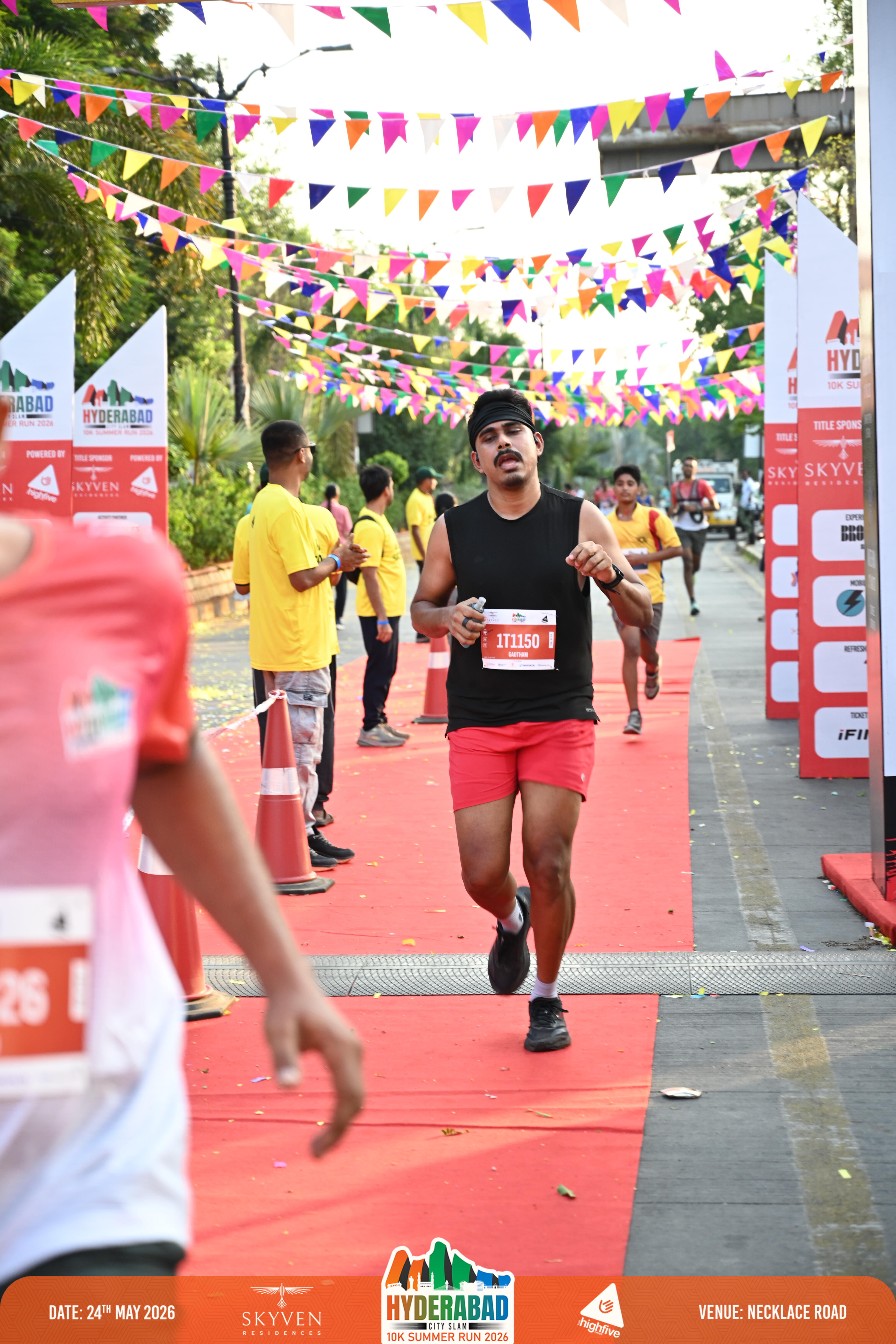
1. “Sitty” hips and limited hip extension.
This is the biggest one and the one I would have missed without the second pair of eyes. Across the mid-race frames the hips sit slightly low and the glutes don’t look fully engaged — I’m running more from the quads than through the hips. Classic pattern for a cyclist transitioning into running: cycling is sagittal and quad-dominant, so the glute medius and posterior chain are under-recruited for the running-specific job.
Cost: I lose stride power, I lose elastic rebound off the ground, and the legs fatigue earlier than the lungs do.
Fix: strength room, not a running cue. Two sessions a week — Bulgarian split squats, single-leg RDLs, hip thrusts, Copenhagen planks, calf raises. Drills before easy runs — A-skips, B-skips, high knees, ankling, strides. The form will then improve on its own as the right muscles wake up.
2. Cross-body arm carriage.
In the finish-line frame both fists are sitting at the centre of the chest rather than tracking front-to-back. The left hand wants to drift toward the right pec; the right hand mirrors it.
Side-to-side arm motion rotates the torso, the hips counter-rotate to compensate, and energy that should be going forward goes sideways. At 4:30/km, this is a real time cost.
Cue: “zip the elbows backward.” Not “pump the arms.” Hands should brush the lower ribs, not the centreline. Thumbs forward, not turning across the chest.
3. Cadence is too low for goal pace.
Visually I’m somewhere around 164–170 spm. For my build and the 4:30/km target, the comfortable home is closer to 172–178 spm. That gap shows up in the photos as longer ground contact and a hint of overstride creeping in when I’m fatigued.
Cue: “quicker feet” during tempo and intervals. Don’t force smaller steps — just turn over faster. Stride length will sort itself out once the hips and calves are doing their job.
4. Hand and face tension late in the race.
Hands are visibly clenched in the finish-line frame. Tension propagates: hands → forearm → bicep → shoulder → trap, and now I’m spending oxygen on muscles that aren’t moving me forward.
Cue: “carry potato chips between thumb and index finger — don’t crush them.” Jaw soft, tongue off the roof of the mouth.
Lower-priority, revisit later
- Slight rib flare and chest hunch in the fatigue frames — posterior chain and core fatiguing before the legs. Strength-room fix (planks, dead bugs, single-leg work), not a cue.
- Right arm slightly tighter than left — could be real, could be camera angle. Side-on phone video at the next race rehearsal will settle it.
What it looks like done well — reference from my old coach
Useful contrast. My old coach (the runner in pink in the photos below) ran the same race in 41:37. Same course, same conditions, five minutes faster. Worth looking at what his form does differently — not because I’m going to copy it stride-for-stride, but because it points at the direction the four cues above are taking me.

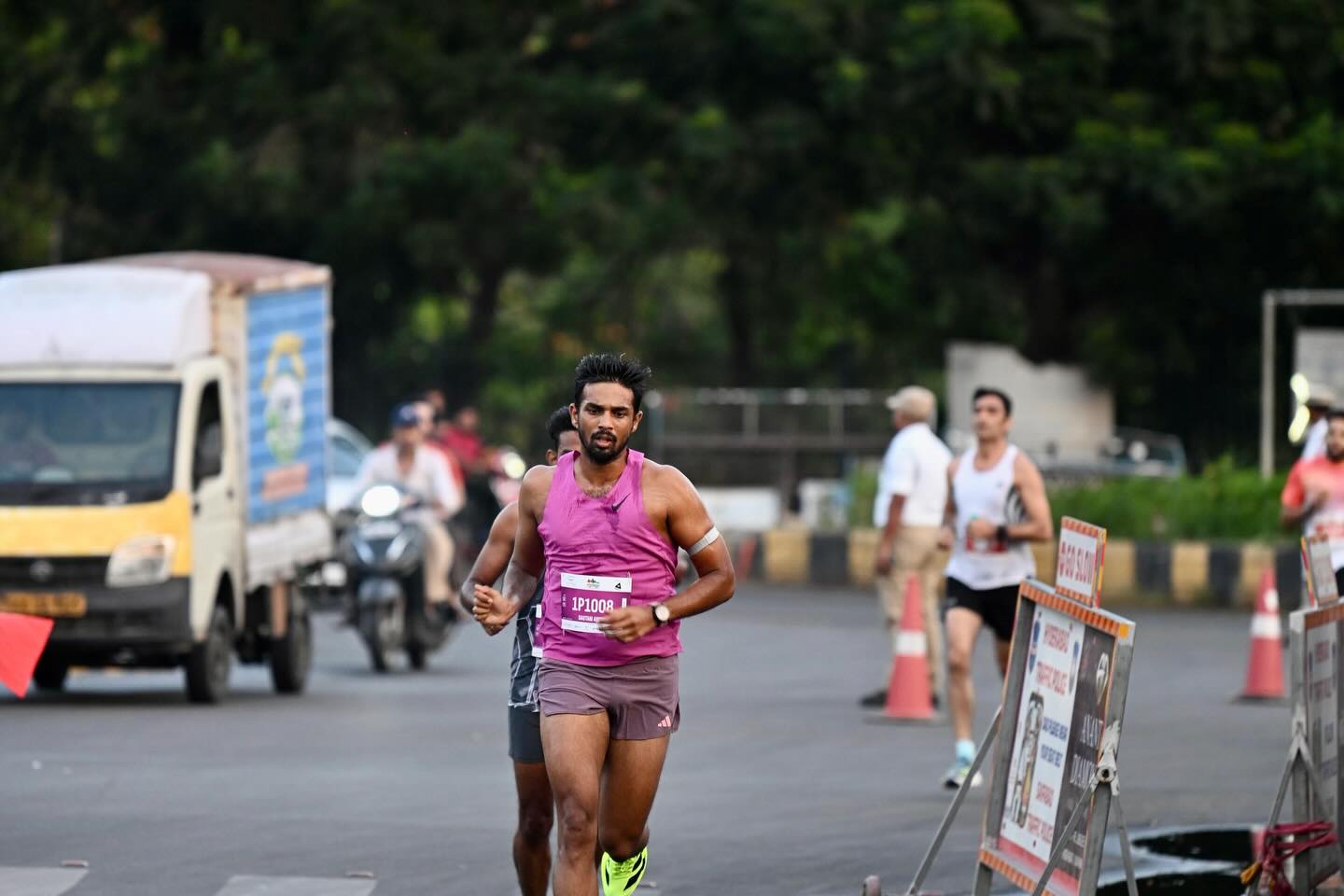


What he does better:
- Hip projection. He runs from the hips — pelvis leading, falling forward into each step. I’m running more from the quads, with the hips sitting slightly behind. This is the single biggest separator and it’s what makes his stride look effortless even though he’s working just as hard.
- Cleaner front-side mechanics. His knee comes through and the foot recovers under the centre of mass before re-loading. My knee drive is lower, the foot recovers later, ground contact lasts longer. Faster cycle = faster runner at the same effort.
- Tight arm carriage. His elbows stay close to the torso and drive cleanly backward. Mine cross the midline. Watch the third frame — his fists never sit at the centre of his chest.
- Elastic stiffness. You can almost see it in stills — he’s bouncier off the ground in a good way. Stronger calves, Achilles, glutes; lower ground contact time. That alone can account for minutes over 10K.
- Relaxation under effort. Jaw soft, shoulders down, hands loose, face controlled — even when he’s clearly working. I’m visibly tighter at the same relative effort. He spends his oxygen on propulsion; I spend some of mine on bracing.
The one-line version: I run with effort. He transfers momentum. That gap is what every workout in the next ten weeks is trying to close.
He’s not genetically freakish in the photos — he just has more accumulated running mileage, stronger posterior chain, and better economy. Which is encouraging, because all three are trainable.
The takeaway
The encouraging line from the analysis: “You don’t need a total rebuild. You need refinement plus running-specific adaptation.”
The biggest unlock is not better form — it’s the things that produce better form:
- Hip and glute strength — 2× a week, alongside the 6-pack strength plan.
- Drills before easy runs — A-skips, B-skips, high knees, strides. Cheap economy.
- Cadence work — quicker feet during tempo and interval sessions; aim for 172–178 spm.
- Arm carriage cue every run — zip elbows back, hands at the ribs, not the chest.
The compact stride, the upright posture, the cycling engine — all of that is already there. The job is to refine, not rebuild.
What’s next
Part 2: the paces and the 10-week plan. I’ll post my actual 24 May 10K finish time, work out the threshold / VO2 / race-pace targets off it, and lay out the week-by-week schedule — including how I’m getting away with ~40 km/week of running by leaning on the cycling base for the aerobic volume. That post answers the question I’ve been asked twice already: if the standard sub-45 plan calls for 65 km/week, how does a 40 km/week runner make it work?
The four cues from this post — strength twice a week, drills before easy runs, quicker feet, zip elbows back — go into every session starting tomorrow.